
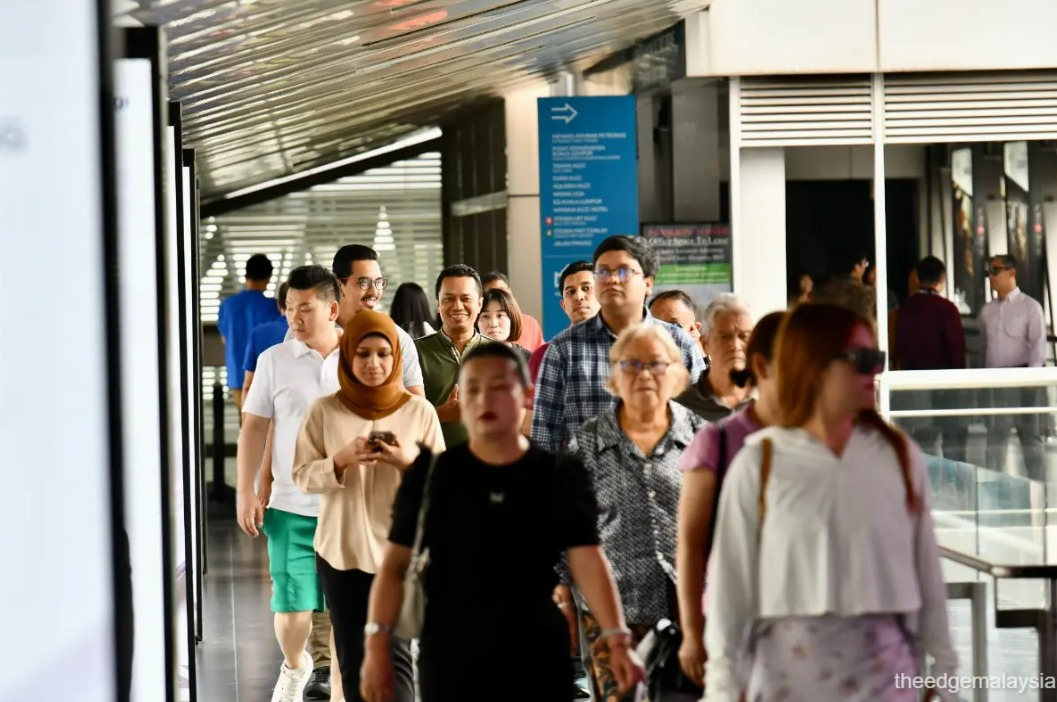
File photo by Sam Fong/The Edge
Many workers in Malaysia earn too little. In 2023, about 30% of employees earned less than two-thirds of the median earnings, a common benchmark for low wages, compared to 13.5% of the OECD average. The main contributing factor is a mismatch between labour supply and demand. The market offers too few high-paying jobs, which reflects the existing production structure. Industrial and labour market policy interventions are required to address this issue.
At the same time, a minimum wage policy is often wrongly seen as a solution. The primary objective of a statutory minimum wage is to set a wage floor that protects workers from unduly low pay. While it serves an important social protection function, it cannot independently resolve structural weaknesses in the labour market. Its effectiveness depends on appropriate coverage, compliance and complementary policies that improve productivity and employment opportunities.
The recent budget announcement on the minimum wage delivers a double whammy. It leads to suboptimal outcomes for social protection and the labour market. The increment from RM1,700 to RM2,000 a month seems good for protecting lower-income earners. However, the exemption for micro, small, and medium enterprises (MSMEs) with annual revenue below RM50 million deserves further scrutiny.
According to the Department of Statistics Malaysia (DOSM), the 2023 Economic Census recorded approximately 1.07 million MSME establishments engaging 6.5 million persons in 2022. MSMEs therefore account for a substantial proportion of employment in Malaysia. Although many of these establishments would likely qualify for the proposed exemption, aggregate MSME statistics alone cannot establish the precise number with annual sales below RM50 million.
DOSM’s formal-sector wage statistics indicate that approximately 28.5% of Malaysian formal employees, equivalent to two million workers, earned below RM2,000 per month in September 2025. However, the published statistics do not identify how many of these low-paid employees work in MSMEs.
Applying the same proportion to the 6.5 million persons engaged in MSMEs would produce an illustrative figure of approximately 1.85 million. This calculation is not an official estimate, as the two datasets cover different populations and reference periods. Nevertheless, it highlights the potentially substantial implications of excluding MSMEs from the new minimum wage.
The proposed exemption consequently raises an important policy concern. While employees of non-exempted establishments would benefit from the higher RM2,000 statutory wage floor, employees of exempted MSMEs could remain subject to the existing RM1,700 minimum wage. This risks creating a two-tier statutory wage structure in which workers performing comparable jobs receive different levels of minimum wage protection depending on their employers’ turnover.
The issue is therefore not merely the magnitude of the proposed wage increase, but the extent of its effective coverage. A minimum wage policy intended to protect lower-paid workers should avoid institutionalising wage disparities through exemptions that are insufficiently targeted, poorly monitored or maintained indefinitely.
This policy has serious long-term socioeconomic implications. First, it can lead to labour market segmentation and persistent low wages. An exemption could contribute to labour market segmentation by allowing otherwise comparable workers to receive different statutory wage protection depending on their employer’s size or turnover. It could also weaken incentives for productivity upgrading in some establishments. The wage policy alone won’t address this issue. It requires a complementary industrial policy to support the creation of higher-paying jobs.
The lower-wage labour market equilibrium may reinforce wage compression by slowing overall wage growth compared with a mandatory minimum wage. Although Budget 2027 also announced a proposed RM2,500 monthly minimum wage for semi-skilled workers and graduates, its effectiveness will depend on the subsequent legal framework, implementation arrangements and enforcement mechanisms.
Second, from a social protection perspective, the legal minimum wage won’t deliver optimal outcomes. As stated by the International Labour Organisation (ILO):
“Minimum wage systems should not be seen or used in isolation, but should be designed in a way to supplement and reinforce other social and employment policies. Several types of measures can be used to tackle income and labour market inequality, including pro-employment policies, social transfers, and creating an enabling environment for sustainable enterprises.”
Overall, thumbs up for the government’s effort to raise the minimum wage. Nevertheless, the effort must align with the longer-term objective of raising the labour market equilibrium to a higher level with relevant progressive policy intervention. Granting exemptions to certain employers doesn’t support the long-term objective without a clear, time-bound transition, productivity support for MSMEs, a clearly specified expiry date, and monitoring of affected workers. Moreover, productive labour market outcomes are crucial for social protection, as Malaysia faces a demographic shift towards an aged-nation society.
Dr Zulkiply Omar is senior research fellow at the Social Wellbeing Research Centre, Universiti Malaya and Malaysian Institute of Economic Research (MIER)
